
How Many Grams Is 1 Cup of All-Purpose Flour?
A standard 200 ml water glass holds approximately 110 grams of white flour, although the filling method and type of flour can change the result.
Quick Answer
Using the 200 ml water glass commonly used as a standard in Turkish cooking, 1 glass of white flour weighs approximately 110 grams. Spoon the flour loosely into the glass and level the top for a more consistent measure; dipping the glass into the flour or packing it down can significantly increase the weight. For precise recipes such as cakes, cookies, and bread, a kitchen scale is the most reliable method.
In This Guide
Key Reasons
| Measurement | Approximate White Flour | Note |
|---|---|---|
| 1 cup | 110 g | 200 ml, loosely filled and leveled |
| 3/4 glass | 82–83 g | Approximate value |
| 1/2 glass | 55 g | Approximate value |
| 1/4 glass | 27–28 g | Approximate value |
In international recipes, “1 cup” often means a volume of approximately 236.6 ml. For example, King Arthur Baking uses 120 g for 1 cup of all-purpose flour in its own measurement standard. Therefore, it is not correct to equate the “cup” in a foreign recipe directly with a Turkish-style 200 ml water glass.
Proper Application
- Check the glass capacity: Use a 200 ml water glass as the practical standard in Turkish recipes.
- Loosen the flour: Gently stir flour that has settled in the jar or package with a spoon.
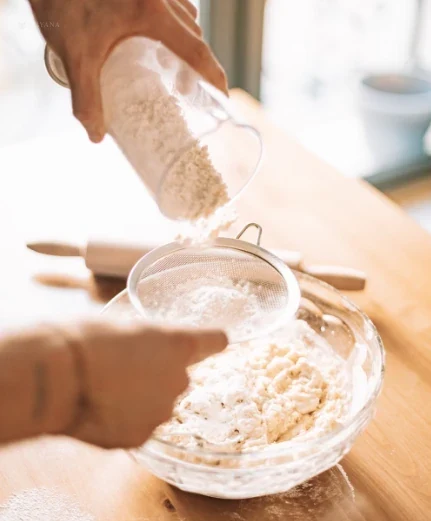
- Do not dip the glass into the flour: Spoon the flour into the glass; do not pack it down or shake the glass.
- Level the top: Sweep off the mound with the back of a knife or a flat spatula.
- Use the practical conversion: For white flour, calculate approximately 110 g for a 200 ml glass.
- Weigh for precise recipes: Especially for cakes, macarons, cookies, and bread, use the grams directly instead of converting them to a glass measure when the recipe gives a weight.
Common Mistakes
Dipping the glass directly into the flour package
Why it causes problems: The flour becomes packed inside the glass, so more grams of flour can fit into the same volume.
Correct use: Spoon the flour loosely into the glass and level the top.
Treating a 200 ml water glass as the same measure as 1 cup in a foreign recipe
Why it causes problems: A US cup is approximately 236.6 ml, and the difference in volume changes the amount of flour in the recipe.
Correct use: Check which measurement system the recipe uses and rely on the gram value whenever possible.
Treating all types of flour as if they weigh the same
Why it causes problems: Whole wheat, corn, rice, almond, and other flours have different densities.
Correct use: Use 110 g as a practical starting point for white wheat flour; use a specific conversion for other flours.
Packing flour into the cup
Why it causes problems: Too much flour can make cakes and cookies especially dry, tough, and dense.
Correct use: Measure the flour without packing it down, leveling it off.
Mayana's Recommendation
Mayana recommendation: To standardize measurements on your site and in your recipes, use the conversion “1 cup = 200 ml; 1 cup of white flour ≈ 110 g.” However, for delicate pastries, give gram measurements first and cup measurements as supplementary information.
- If you are using a new cup, first measure its capacity with water to check that it really holds 200 ml.
- If you make the same recipe often, weighing your cup of flour once and noting your own flour measurement will improve consistency.
Additional Information
It is normal to find different values, ranging from 100–120 g, for 1 cup of flour in reference sources. This is due to the cup’s capacity, the type of flour, its moisture content, and the way it is filled. Therefore, “110 g” is not an exact physical constant, but a practical Mayana conversion for home kitchens using a standard 200 ml cup.
More Kitchen Information in the Ingredients and Measurements Category
Find explanations, tips, and practical information published in the Ingredients and Measurements section, all in one place.