
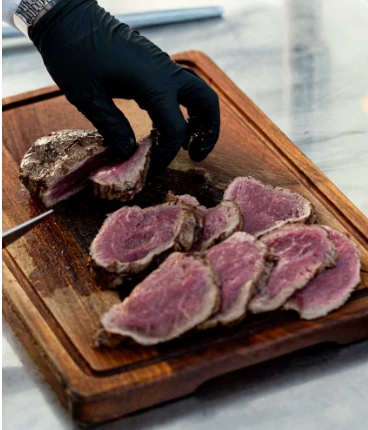
Why Should Cooked Meat Rest Before Slicing?
Learn how resting meat affects temperature control, moisture loss during slicing, and serving quality, including the difference in timing between a thin steak and a large roast.
Quick Answer
Briefly resting cooked meat, especially thick steaks and roasts, helps the internal temperature even out and allows carryover cooking to finish. The explanation that meat draws all of its juices back in is not considered accurate on its own; current tests show that moisture loss during slicing is strongly related to the temperature at which the meat is cut. For safety, the USDA recommends resting whole cuts of beef, lamb, pork, and veal for at least 3 minutes after reaching an internal temperature of at least 62.8 °C.
In This Guide
Key Reasons
-
After meat is removed from the heat, the outer layers remain hotter than the center. Heat continues moving toward the middle; this is called carryover cooking. A short rest helps the temperature become more even at serving and allows you to account for this process so the target doneness is not exceeded.
-
The classic explanation says that resting lets the meat's juices be fully reabsorbed into the fibers. Newer experimental studies suggest that the difference in moisture loss between rested and unrested meat cut at the same temperature may not be as large as commonly believed. The most reliable benefits of resting are therefore temperature management and serving control.
Proper Application
- Remove the meat from the heat or oven as it approaches the target safe internal temperature, and account for the increase from carryover cooking in thick cuts.
- For a whole cut of red meat such as steak, follow the safety rule of reaching at least 62.8 °C internally and resting for at least 3 minutes.
- As a practical starting point, rest thin steaks for about 3–5 minutes, thick steaks for 5–10 minutes, and large roasts for around 15–30 minutes depending on their size.
- Do not wrap the meat tightly in an airtight covering; if you use foil, keep it loose to prevent steam from softening the crust too much.
- After resting, identify the direction of the fibers and slice across them for pieces that are easier to chew.
Common Mistakes
Slicing a Large Roast Immediately After Removing It from the Oven
Why it causes problems: The internal temperature may not have evened out yet, making carryover cooking harder to control.
Correct use: Give the meat a controlled rest based on its size.
Assuming that resting magically makes the meat reabsorb all of its juices
Why it causes problems: More important variables, such as the cooking temperature and the temperature at which the meat is cut, may be overlooked.
Correct use: Treat resting as a way to manage temperature, carryover cooking, and serving time.
Wrapping the meat too tightly in foil and leaving it for too long
Why it causes problems: Steam can soften the nicely browned exterior and increase carryover cooking.
Correct use: Use loose foil if needed and monitor the internal temperature.
Mayana's Recommendation
- Mayana recommendation: For large cuts of meat, a thermometer is more reliable than timing alone. After removing the meat from the heat, monitor the temperature as it rises by a few degrees and then levels off.
- For steak where the crust is especially important, a very brief re-sear in the pan for a few seconds after resting can revive the exterior texture.
- Slicing just before serving reduces heat and moisture loss compared with slicing in advance and letting the meat sit.
Additional Information
Ground meat products require different safe internal temperatures: target at least 71.1 °C for ground beef, lamb, and pork, and at least 73.9 °C for all chicken products. Use a thermometer rather than visual cues.
Frequently Asked Questions
How Long Should You Rest Steak?
For thin steaks, about 3–5 minutes is a practical starting point; for thick steaks, use 5–10 minutes. Thickness and the target temperature can change the timing.
Does Meat Reabsorb Its Juices When It Rests?
This classic explanation is oversimplified. Current tests show that the temperature at which the meat is cut plays an important role in moisture loss.
How Long Should You Rest a Roast?
Resting for approximately 15–30 minutes can work depending on the size; the most accurate check is to monitor the internal temperature.
Other Kitchen Tips in the Mayana Tips Category
Access the other explanations, tips, and practical information published in the Mayana Tips section from a single screen.